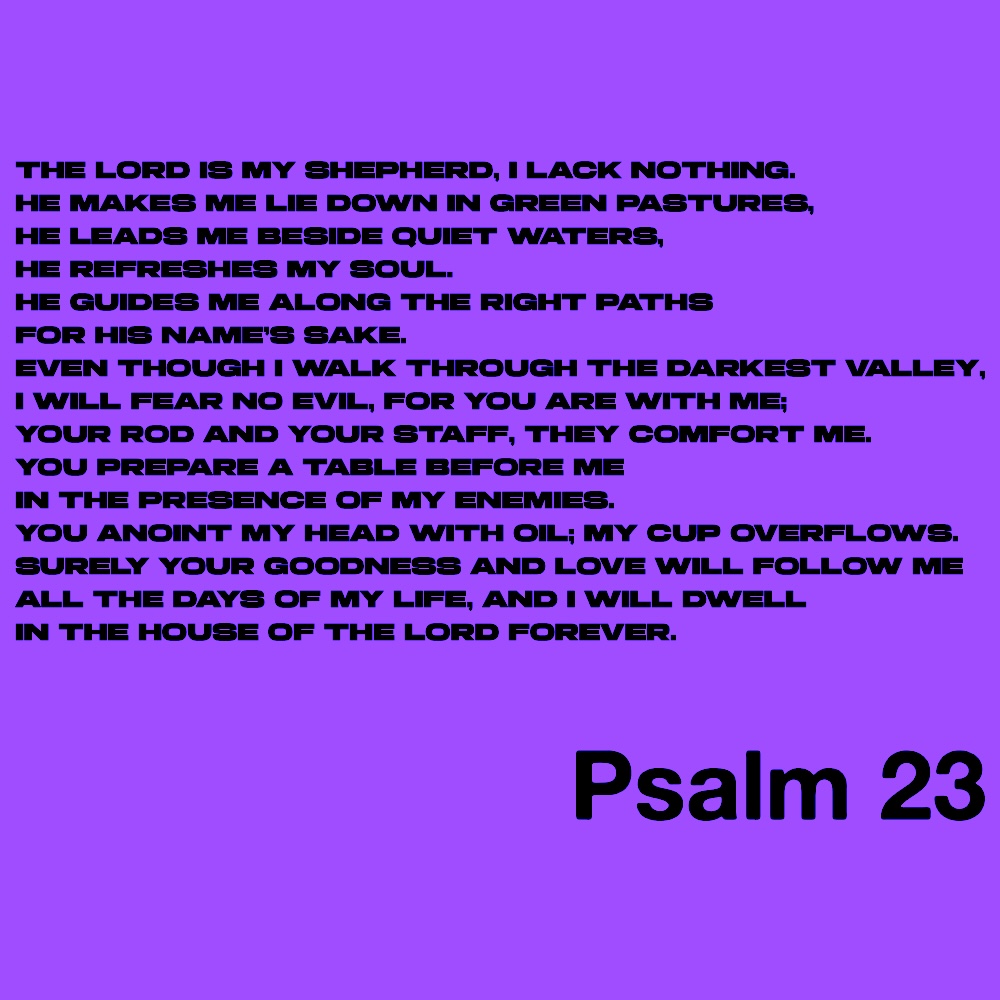
• Beautiful words, we love Psalm 23, how many of us would say this is our favourite passage in the bible! At least top 3 for many of us. Look to choose a few words/title for our screen, can’t go past whole thing!

    So many good things for us in these words David writes, and not only good things on their own but good things in the middle of really bad things > there’s mention of the ‘darkest valley,’ of ‘evil’, and of ‘enemies’ – 3 bad things there, 3 bad things that these words speak powerfully into

    And there’s something under the surface a bit here I want to focus in on this morning > we know about God’s provision don’t we > with Jesus as our shepherd we lack nothing! Nothing at all, we have everything! We’re well provided for right there aren’t we >>>

    What else is in there? 

    Green pastures, quiet waters, the right paths, God’s rod and staff for our protection and comfort, a table prepared before us – in the presence of enemies no less. 

    There is refreshment for the soul, what a beautiful and powerful thing that is, what we get when we receive God’s holy meal together as well. 

    We get goodness and love, and that goodness and love goes with us now and forever as we get get to dwell – to live, to belong, to remain – in God’s house.

    And we’re anointed, to the point where out cup overflows, meaning we’re set apart, we’re given a new identity in Christ, a new calling on our lives.

    And that last one points to the part that sits under the surface here, I wonder if you see it >

    The part that sits under the surface is the part about God’s call on our lives, on our hearts. God’s call not to only sit still, but his call to MOVE, to go, to do and to be. 

    Yes there are times to sit still, of course Psalm 46 says ‘be still,’ but be still for what reason? 

    To know who God is. That’s the reason, that’s why we need to be still. To be still in this way is to quiet your heart and mind, to hand over the troubles and concerns of life to God and hear from  him what he has to say to you.

    So sitting still is good, being still so we can know God and his will for us is very good, hugely important for us to do and keep doing of course – but we’re not called to sit still and stop there. 

    We’re not called to watch on from a distance, we’re not called to let other people do the work, we’re not called to become slack or lazy or disinterested in the meaning and the purpose of why God has put us here. 

    And there’s a challenge in there for us > an opportunity to reflect on our own lives. 

    Think about these questions for a moment:

    Have we sat still for too long, when we should be MOVING, we should be doing, going and being?

    Have we become slack or lazy in our walk with God? Yes we might have heard who he is and what he’s done for us, but do we know what that really means for our life? Do we have an actual living relationship with our good and gracious God? Are we really aware of how that changes our life, how that changes the world, how reality gets shifted as we mentioned last week by who God is, what he’s done and what he continues to do??

    Do these words here on the screen before us today, do these words matter to us? Do they make a difference to our everyday life, or have we fallen into a loop of hearing it on Sunday then forgetting it by Monday?! It’s ok that does happen!

    Some hard questions to face there, things we all struggle with. We’re all in the same boat here, struggling with these things together! Life together in community is nothing if not a shared struggle!

    In this shared struggle we might hear these words and think, ‘that’s what I want, that’s why I need right now! That’s what that person close to me, that loved one needs right now!’ 

    These good things like green pastures, quiet waters and refreshment for the soul. Very good things!

    But along with the sense of being still and knowing God, of receiving and hearing from him in our shared struggle together, there is also a sense of movement. Of the call to MOVE, not only sit still but get moving…

    Being ‘led beside’ the quiet waters.

    Being ‘guided along the right paths.’

    ‘Walking through’ the darkest valley. 

    ‘Being in the presence of enemies’ – not somewhere any of us want to stay for too long!

    And being ‘followed’ by God’s goodness and love, not just for a moment but forever!

    Do you see what I mean when I say there’s a sense of movement there? Not only sitting back and receiving good things, but how those good things go with us and move us forward. They compel us to move, they mobilise God’s people, they empower us to move, to go, to do and to be exactly that, God’s people!

    Jon Foreman, someone I’ve mentioned before, lead singer of the band Switchfoot and a solo artist as well, has some good bits and pieces on Psalm 23 – he has a song called ‘House of the Lord Forever’ that’s based on these words, and his band has another song called ‘Dare You To Move.’ 

    I think that’s something that God actually says to us, and something we can encourage each other in > I dare you to move. 

    There are some really interesting lines in this song, things like redemption and forgiveness and salvation are all mentioned in this song! Worth a listen if you get a moment, might not be your favourite style of music but very interesting lyric-wise. 

    Being dared to do something is usually associated with that thing being hard to do! And we might think about being dared to do something in a negative light, as in being dared to do a bad thing. 

    But if we turn it around and think about it in terms of doing good things, receiving and living out of the good things of God – all the things we hear about in Psalm 23 – then it hits a bit different. 

    We hear God saying ‘I dare you to love your neighbour, even love your enemy.’

    Maybe that sounds a bit hard right out the gate – I dare you to pray for your neighbour, to pray for your enemy. 

    I dare you to serve or to give to someone in need. I dare you to share a kind word with someone, even if they haven’t had a kind word for you.

    I dare you to put your hope in God, Father, Son and Holy Spirit, this God who knows you as his own child, part of his own family. Put your hope in him like your life depends on it – because as we know, it does!

    And a key thing to remember in all this daring and daring activity > who’s right there alongside you all the way, who will always be there for you and who will use you for his good purposes, even if you don’t know it at the time??? Who did the most daring thing anyone could do and gave up his life so you could come to know him? 

    THE LORD YOUR SHEPHERD, who makes you lie down in green pastures. 

    Who leads you beside quiet waters.

    Who refreshes you in your soul. 

    Who guides you along the right paths, not as in ‘correct’ in human terms but as in HIS path, even when you’re in the darkest valley, who gives you the comfort and strength and hope to carry on and to not fear the evil one.

    Who prepares a table – as in giving you what you need – not only when things are all good but when you’re in the presence of enemies. A place no one wants to be, but even there the Lord your shepherd is with you.

    Who keeps filling up your cup to the point where it overflows! He has more than enough to give you, and when you know him you see just how much he has given you, is giving you and has in store for you too!

    What’s in store for you and me?

    Goodness and love, all the days of our lives, as we dwell in the house of the Lord forever. Not bad.

    Amen to that, receive the peace of God today in your hearts and your minds, may his peace be with you and may you know how much he has for you.

    Lord we thank you for your abundance, all the things you have done for us and still have in store. Remind us of your presence, when things are great and when we’re in the thick of difficult times too. Compel us as your people to MOVE, to do and to go and to be who you call us to be. All these things we pray in Jesus’ name. Amen.

    //
  • Have you ever been disappointed??

    Have you ever been disappointed by something that happened in your life, by someone in your life? 

    I think if we answer honestly we would all say ‘YES,’ we have been disappointed. By something, someone, whatever it may be. 

    So if we know disappointment happens in life, let me ask you this: when was the last time you were disappointed?

    Maybe it was this morning, maybe your toast was in the toaster a bit long and now it’s burnt.

    Maybe it was over the weekend when you wanted the weather to be a certain way, but it had other ideas. 

    Maybe your sporting team didn’t do so well in their last game.

    Or maybe you were disappointed on a more serious level >

    Maybe you were disappointed by the actions or inactions of someone you love.

    Maybe you were disappointed by someone not listening to you, someone not hearing what you were saying.

    Maybe you were disappointed by an expectation you had of someone or something not turning out the way you had planned. 

    Maybe you even felt disappointed by God himself, that’s a big one to get into!

    Many ways we can be disappointed, small thing and bigger things. 

    And what happens when we feel disappointed?

    We get a bit down, a bit low. 

    We might feel different emotions, sadness, frustration or anger even.

    We might become a bit negative, a bit cynical, a bit withdrawn and resigned, we might feel like giving up on that something or that someone that has disappointed us. I’m sure we’ve all been there.

    So that’s a bit about disappointment, being disappointed, what being disappointed feels like. You might have some thoughts and experiences you reflect on there.

    Why are we talking about this today, being disappointed??

    Why would we be talking about that on a day like today, when we’ve just witnessed a young child being welcomed into God’s family through the waters of baptism, what a joyful thing to celebrate – why are we talking about disappointment?!

    Because we get disappointed. Disappointment happens. 

    Because it’s worth acknowledging that disappointment happens in life, it’s worth admitting it, it’s worth talking to God about it, and it’s worth hearing what he has to say about it.

    So what does God say about disappointment – today in our second reading from Romans 5 we hear something about disappointment, about ‘being put to shame.’ 

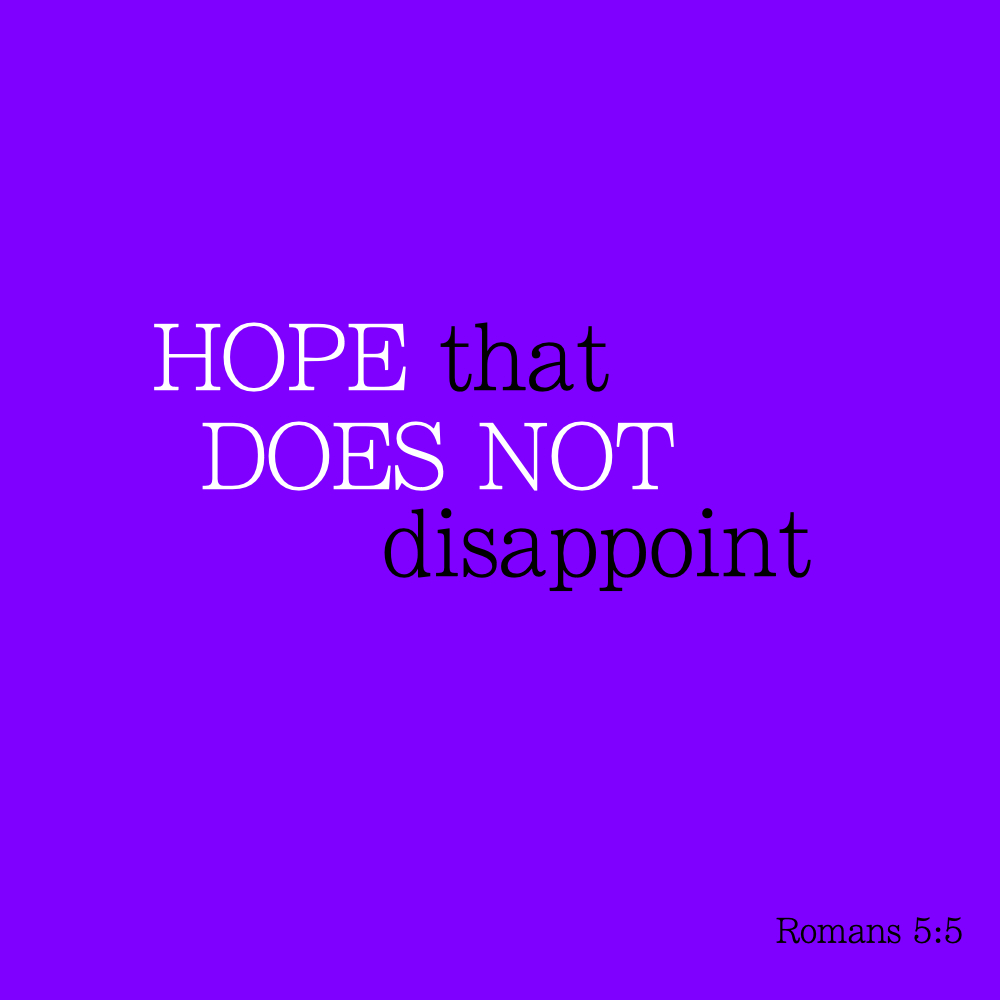
    That’s the end of the sentence, but what do we hear at the start? ‘HOPE DOES NOT.’

    HOPE DOES NOT put us to shame, HOPE DOES NOT disappoint us. 

    That’s how Paul puts it, HOPE is the key ingredient God provides here in the midst of disappointment, of being put to shame.

    So we’ve got two contrasting things now, the disappointment of our experience as human beings – even disappointment with God himself – contrasted with the HOPE God gives, the HOPE he provides, the HOPE that is always there for us.

    So let’s talk about HOPE for a moment, what does God say about this HOPE??

    Paul goes right into it today, this passage is absolutely packed with one-liners and phrases that summarise the goodness of our God and what he’s done for us – maybe there’s even too much in here, too much for us to take in in one go, too much good stuff that what we really need to do is SLOW DOWN, slow down to hear just one or two things about what God has to give us today.

    So I can give you one or two things: Paul says Jesus ‘died for the ungodly’ (that’s us by the way, all people are in that category until God did something about it), and he didn’t die for them because they were wonderful people and they deserved it. He died for them ‘when we were still powerless’ Paul says. Not powerful, power-LESS. We had nothing to give our God, but he had everything to give us. 

    While we were sinners even, sinners aka people who actively went against God, even then Jesus had enough love to give us to cover our wrongs and make us his. 

    And Paul’s not done yet, while we were God’s enemies he had this love to give us. 

    Powerless, sinful, enemies of God – not something we would call ourselves!

    Imagine introducing yourself to someone and saying that! ‘Hi, my name’s Tom and I’m a powerless, sinful, enemy of God – until Jesus changed my life and made me his own child’ – add on that second part and it sounds a bit better!

    Powerless, sinful, enemies of God is what we are without the saving grace of Jesus. There is HOPE in that, serious HOPE, even our ONLY HOPE we could say.

    In that gospel video we just saw from John 4 there’s one line I want to pick up from what Jesus says to the woman at the well, this woman who Jesus knows intimately, even though she’s of a different culture to his own and most people from his culture would not be associating with her as Jesus does!

    What does Jesus say to her about water, about being thirsty:

    John 4:13, 14 – ‘Everyone who drinks this water will be thirsty again, but whoever drinks the water I give them will never thirst’

    She’s a bit confused by what he says – aren’t we all at times! – she asks ‘where can I get this living water?’ And Jesus redirects her to show her how intimately he knows her, what he knows about her life. Things in her life she might not be proud of, things she might not want other people to know!

    Let me bring in disappointment again here – when we have these serious-level disappointments in our lives, when we feel ‘put to shame’ even and we really don’t want anyone else to know about it, what we hear from Jesus is that he already knows.

    He knows without us saying a word to anyone else. 

    God knows our deepest disappointments, the disappointment of the burnt toast and the disappointment of the person we love letting us down. God knows our hearts and minds – because he is our creator, of course he knows what’s going on in our hearts and minds! 

    So if you’re ever feeling disappointed – even by God himself – let him know! It’s ok to tell God you’re disappointed, acknowledging what’s really going on in your life is a key ingredient for us in building a relationship with him! Talk to him, share what’s on your heart and mind with him. Tell him how it is, know that his listening ear is for you, and then listen to what he tells you next.

    Back to the woman at the well > So what this woman hears here from Jesus is significant – the words of Jesus are not just nice, kind, thoughtful words. Not just about doing the right thing and avoiding the wrong thing – so much more than that! 

    The words of Jesus are LIFE-CHANGING words.

    WORLD-changing, REALITY-SHIFTING words. Just look at what happens next in this woman’s community > she tells her people about this guy and the words he said to her, and the verse is: ‘Because of his words many more became believers’ (John 5:42). 

    Many more became believers, BECAUSE OF HIS WORDS. 

    They heard the words of God from the mouth of Jesus. And that’s how it happened, that’s how it happens today!

    We hear the words of God too – these same LIFE-CHANGING, WORLD-changing, REALITY-SHIFTING words are for us too. 

    We heard a bunch of them in the baptism today – let the children come to me, ask and you will receive, receive the forgiveness of your sins and be part of my family – all words we’ve heard today, all words from God that give us SERIOUS HOPE. 

    Words to live by, words to depend on in times of need, like when we’re disappointed.

    These are words to live by, words to depend on because the HOPE our God gives DOES NOT disappoint. 

    It DOES NOT disappoint, instead it gives us new life. Peace. Joy. Protection. Wisdom. Knowledge. More things we could add to that list. The open-hand of a loving relationship with out creator himself. That’s what God’s HOPE gives. 

    SERIOUS HOPE, a HOPE that DOES NOT disappoint. 

    Thank you heavenly Father for being our hope, for giving us hope, even when we feel anything but hopeful. Remind us you’re there for us always, you always have HOPE to give us, you always have a listening ear we can turn to, and you always have the words of life that give us hope for the soul. We pray this in Jesus’ name, Amen.

    //

  • We’re in the last week of our three-week look at these words from Micah – ACT JUSTLY, LOVE MERCY, and today: WALK HUMBLY, with your God. 

    WALKING HUMBLY, maybe the most difficult of the three – maybe depends who you ask there or what the scenario is, but the idea of WALKING HUMBLY is something that really goes against our natural instinct as humans…

    Yes we say we want to see JUSTICE, justice and fairness in the world, that makes sense. And yes we ask God for MERCY, we ask him to have mercy on us weary sinners and we know – going by what God’s word says – that he does give mercy, he is a merciful and loving God. We know about that, it makes sense to us. 

    But this WALKING HUMBLY, to walk with humility, to live our lives with humility – this one clashes a bit with our modern worldview, maybe it even clashes a bit with our view of who God is and what this Christian life is all about, this one is hard. This one takes the agency or the control out of our hands – we don’t like it when that happens do we! 

    This puts us at the mercy of the world around us, and at the mercy of the God who made us and says he cares for us. To be HUMBLE is to be vulnerable isn’t it, we don’t really like that – we’d rather be comfortable than vulnerable. 

    Like with JUSTICE and with MERCY, we’ve heard how these two things are God’s to govern and God’s to give. HIS justice is the ultimate justice, his MERCY is the ultimate mercy. He governs our hearts, he has mercy on our souls.

    But along with being JUST and MERCIFUL, our God is also HUMBLE. Our God is humble, he operates with HUMILITY – how do we see this? In the person of Jesus, in the life and death and resurrection of Jesus. If you want an example of humility, what it is to live a humble life, we have it in Jesus.

    Let’s think about what the bible means by the term HUMBLE >

    It means low, being made lowGoing low, just how God makes himself low, he comes down to meet us in the person of Jesus. You can’t get any more HUMBLE than that! 

    The creator of the universe inserts himself into his own creation, submits himself to the struggles and limitations of this life. Submits himself even to death on a cross, put there by the very people he came to save as we know. That is HUMILITY.

    So for us, being HUMBLE, WALKING HUMBLY, living with HUMILITY – this is not easy. This is hard. Extremely hard – we could never live as humbly or be as humble as Jesus. Like how he never sinned, he was always humble. The perfect person, we can’t measure up to that standard.

    This is how Jesus walked, he shows us the ultimate version of WALKING HUMBLY [image of Jesus carrying the cross]

    A striking symbol of humility, how he was made to carry his own cross. 

    So we know about that, we are in awe of the love and grace and compassion and mercy God has given us, Jesus has won on the cross for us.

    But what does it look like for US to WALK HUMBLY, how does God call us to walk as people living in the 21st century, in the second half of the 2020’s now, whatever stage of phase of life we might be in. Whatever our roles might be – spouse, parent, sibling, child, friend, colleague. 

    This next image might give us something go on [image of two people walking together down a forest track]

    WALKING HUMBLY, walking together, listening and being listened to.

    Moving in the same direction. 

    On the same page. 

    We can think about this image as two people walking humbly together on the journey, but also as God walking right next to us as we walk the walk of this Christian life, of a life of a follower of Jesus. That’s the walk we’re on, and not only has he paved the way for us but he’s also right there with us. 

    So with that image in mind, WALKING HUMBLY with our God, I want to pull out a few verses we’ve already heard today > always good to notice what comes up in our readings, listen out for the details letting us know about who God is and who he says we are, that’s the most important stuff for us to hear. 

    First we heard the story of Moses on the mountain today, Moses is called up the mountain so God can talk to him, he has important things to tell and to give Moses.

    That would’ve been a HUMBLE walk for Moses, you’ve been summoned by God because he wants to see you!

    But this is not a God who only corrects or rebukes or tells off – that is not the full picture of who God is. The full picture is more like God saying to Moses, ‘‘Come and spend time with me, I will give you what you need.” That’s what God’s saying here. 

    Not just a ‘do what I say’ one-way conversation but a loving embrace, a kind word, a shared moment. Spend time with me God says, I want to spend time with you. 

    How do we know God wants to spend time with us? How do we know he cares for us, deeply and intimately? Jump ahead to our other two readings today and we see the answer.

    In both texts we hear the same words, both 2 Peter 1:17 & Matthew 17:5 refer to what God says about his son Jesus – God says ‘This is my son, whom I love; with him I am well pleased.’

    This is the loving God we have, the good Father, the present Father who cares for us on a deeper level than we know. 

    He says about his son that he loves him and he is pleased with him – and that’s before he’s done anything! It’s not Jesus actions that earn him his Father’s love, it’s the free gift of a loving Father who also has this same love for all people.

    When we’re baptized we’re baptized into God’s family. That means these same words apply to us, like it says in the Psalms – at our baptism God says ‘You are my child; today I have become your father.’ (2:7)

    God says about us that we are his children, that he loves us, and with us he is well pleased – before we did anything. The amazing love of our Heavenly Father there. 

    So from Micah we learn that we are called to ACT JUSTLY, in line with what God says. 

    We are called to LOVE MERCY, to receive the incredible, undeserved mercy of God, and have mercy on others as God would have us do.

    And we are called to WALK HUMBLY, to make ourselves low, to lower ourselves so others can be lifted up – just as our God does for us.

    WALKING HUMBLY is putting our lives in God’s hands, who is the one who has what we need. He is our good Father, a good Father who loves his children.

    Jesus is God’s son, and God loves him. You and me are God’s children, and he loves us. We are brothers and sisters of Jesus himself, part of God’s own family – this is an intimate relationship, not distant/far-off/sometimes, it’s all the time, constant, reliable, ongoing.

    We’re not random strangers to God, he is our good Father. We’re not random strangers to Jesus, he is our brother. And we shouldn’t be random strangers to each other either! We’re all part of the same family, the family of God, the body of Christ. We have the gift of this life to live, community to share in together, and that’s community always with an open door – to invite people in and to move through so we can meet people where they’re at, just as God does for each of us. 

    HUMILITY is a key ingredient in all this! Listening and being listened to, moving together in the same direction, being on the same page as we do life together in community. Not easy but incredibly important for us. 

    God says about each of us the same thing – not just some of us, not just me, not just you. He says about each of us that we are his, we are part of his family, he has good things for us and we can depend on him. God has put us all on the same page aready! The page that says ‘my beloved children.’ That’s the list we’re on, that’s the sort of thing that builds community right there, out of God’s love he’s shown us and the love we can show each other. 

    [Listen to Pat Barrett’s song – ‘Act Justly, Love Mercy, Walk Humbly’]

    Lord help us to act justly, to love mercy and to walk humbly with you. Help us to get ourselves out of the way so you can speak to us and guide us to show love to others, to use the gifts you have given us, to help those in need and grow in our relationship with you. All this we pray in Jesus’ name, Amen.

    //

  • We’re in the 2nd week today of a 3-week look at some words coming out of the book of Micah, these words from 6:8 > ‘What does the Lord require of you? To act justly and to love mercy and to walk humbly with your God.’

    We started off last week thinking about the first part of the answer, the ACTING JUSTLY part > what does it mean toΑCT JUSTLY, what is JUSTICE – we looked at what the world might say about that, and what God says. 

    We heard that God is our judge, he is the ultimate judge over us, over all people, and to ACT JUSTLY is to act how God calls us to act, in line with what he says.

    But our God is also a God of love, his judgment is MERCIFUL – and that brings us to our key words today:

    LOVING MERCY. What does God ask of us here? To LOVE MERCY. 

    What does that mean, what is Micah talking about there, what is LOVING MERCY in God’s eyes??

    Usually the best place to start with questions like these, what is the bible talking about here, what is the deeper layer of meaning underneath all this > is the bible itself! Turn the page, what else is going on here?!

    Letting ‘scripture interpret scripture’ we call it, God’s word revealing to us what God’s word means!

    So if we’re asking what Micah’s talking about when he says God calls us to LOVE MERCY, a good place to start is to ask: where else does God talk about this??

    We have so much information, so much content to go on! We don’t have to come up with the answer ourselves, there is already so much there for us to dig into to get to closer to the bottom of what this all means. 

    Two other things for us before we think about some of these deeper meanings and layers, two tips for how to read the bible: (I always feel I need to be very careful here when I’m speaking to people who already know about this stuff or who may work in the teaching profession themselves, so the best thing I can do is to share what I’m learning and growing in I think and hopefully there’s something useful for you there!)

    1. Taking our time. Slowing down, stopping and giving ourselves time to think > this is not something to rush through and tick off as quickly as we can! If we always do that we will almost always miss something important God has for us. 
    2. Keeping an open mind, which taking our time helps us with! Taking God at his word, noticing how it hits us, making note of the questions or concerns or amazing things we might hear, and then we can really start to learn and grow in our faith. Letting the Holy Spirit in, so he can teach us how God works.

    So to understand what it is to LOVE MERCY, I’ve got 3 verses for us to think about: 

    Our theme verse here from Micah 6, a verse from Lamentations 3, and another verse from James 2 – broad spectrum there, different words from different eras but packaged together in this thing we call the bible for the purpose of what? For the purpose of helping us to know God. To know who he is, what he’s done for us and who he says we are. 

    Micah 6:8

    ‘Loving mercy’ here goes alongside ‘acting justly’ and also ‘walking humbly,’ which we’re going to look at more next week.

    What is MERCY??

    “Compassion or forgiveness shown towards someone whom it is within one’s power to punish or harm.” (Oxford Dictionary)

    That already sounds biblical doesn’t it! Compassion, forgiveness > 2 things God is pretty big on

    And also the bit about holding power… God does have the power to punish or harm us > that’s true, he could do that to us if he chose to, he is God and we are not!

    Sometimes the dictionary can throw up very different definitions of words in the bible – different understandings from ancient times to modern times today – but this one hasn’t changed a whole lot has it! And ‘mercy’ probably isn’t a word we use a whole lot today either… Maybe in sport where a team is getting badly beaten and the winning team applies the ‘mercy rule’ where they ease up a bit.

    So we get what MERCY is, not only stopping the punishment but showing compassion and forgiveness even… But what about LOVING mercy? Easy to love mercy if you’re on the receiving end! 

    If you’re that team that’s getting badly beaten you might happily receive some mercy, so the punishment can stop! 

    But what if you’re the winning team, the team that this game has been a ‘walk in the park’ for… Maybe it’s a bit harder to give mercy than to receive it…

    This is where we hear about what our good and gracious God does, our loving and merciful God does:

    Lamentations 3:22-23

    2 translations for you here, NIV:

    ‘Because of the Lord’s great love we are not consumed, for his compassions never fail. They are new every morning; great is your faithfulness.’

    And here’s the ESV, which brings in the word MERCY:

    ‘The steadfast love of the LORD never ceases; his mercies never come to an end; they are new every morning; great is your faithfulness.’

    It looks like there’s a bit of blending of meaning going on here, but it does all come back to a central idea:

    The Lord’s great love is actually a translation of the original Hebrew word for – you guessed it – mercy, which can also mean ‘great love’ or ‘steadfast love’ as we see in the other translation. 

    God is a God of all these things > he has mercy, he has great love, he has steadfast love, he has compassion, faithfulness, and maybe the best thing about this verse: the ‘new every morning’ part.

    All these things, from God and for us, are available to us, given to us each new morning, it doesn’t stop! How good is that, if we’ve had a bad day, a bad sleep, if we’re tired or sick or struggling and also when we’re going ok or even really well > God has all these things for each of us each and every morning. That’s faithfulness right there isn’t it, also loyalty – another way the original word for mercy is translated. Loyal, steadfast love > love that keeps on going, the gift that keeps on giving!

    Third verse to touch on today, this one gives us some direction for how we should act based on how God has already acted towards us:

    James 2:13

    ‘Mercy triumphs over judgment’

    We also see in the rest of this verse that those who judge without mercy will not be shown mercy themselves – words of warning there, being wary of our own actions and the way God acts – but at the same time we know God is a God of forgiveness and compassion, who’s judgment is merciful.

    When we turn to him, we put our lives in his hands, there we can receive what he has already done for us, we can receive the judgment he hands down > LOVING MERCY. 

    And this is where Jesus comes in > the one who came to live among us, who died on the cross for us, who rose again so we could have life with him. Jesus’ death on the cross is where God’s judgment is made, his judgment that we should all be called guilty, but God says I will call you loved, my own children, part of my family. A judgment of MERCY that we do not deserve, but it is the one we receive. 

    It’s an incredible thing that Jesus would wear all that for us, he would pay the price for our sin, but it is the core and central message of all this > Jesus loves you, he loves me, he loves us enough to give his life for us. And he has done that, and he also beaten death and the devil (no ‘mercy rule’ there!) so we could have life with him and life to the full.

    So we can say that to ‘LOVE MERCY’ is to receive the MERCY God offers us, and to share that same MERCY with others, with those we LOVE personally, we those we are called to love > love God, love each other as the bible teaches. ‘Let your light shine’ as we heard in our bible readings today, in God’s love we can ‘be like a well-watered garden, like a spring whose waters never fail’ Isaiah says, beautiful imagery.

    To love something is to be all about something isn’t it, in the same we love our partner or our kids or maybe even our work or our sporting teams or our hobbies! 

    We say we love those sorts of things, and to know who God is to know that he loves us like that – he loves us not only like a favourite team or weekend activity but much more than that, as a unique, gifted, loved, seen and known individual that he has made and who he calls to do life with him. 

    So I pray the peace of God, the LOVING MERCY of God that passes all understanding would guard our hearts and minds in Jesus’ name. Amen!

  • New series coming out of Micah today, focussing on one key verse: 6:8 > ‘He has shown you, O mortal, what is good. And what does the Lord require of you? To act justly and to love mercy and to walk humbly with your God.’

    Out of that one verse we’re going to pull out two key words today:

    ACT JUSTLY.

    We hear ‘act justly, love mercy and walk humbly,’ and we’ll look at those other two in the next two weeks. 

    What comes to mind for you when you hear these words, ACT JUSTLY??

    Maybe you think ‘do what is right,’ ‘do what pleases God.’ Act in a way that is just > what does JUST mean, what is Micah referring to when he says these words, when he passes on these words to the people?

    BEFORE we dig into that question, it’s important to consider our posture, how we’re going to come at these words as we hear them over the next few weeks > these words ARE NOT simply instructions for living, things we must do, rules for living a good life in God’s eyes. 

    They are of course very helpful in teaching us how to relate to other people (and to our God). When we know who God is and we have faith in him we are compelled to live the life he calls us to live – it becomes part of our purpose as Christian people. And in terms of the concept of living a good life in God’s eyes, yes these are very good and important things for us, but there is more to our faith journeys than following a list of instructions, as if that will make God happy with us! 

    So there is more than simply God saying ‘do this and do that’ going on here. 

    Let’s have a look outward at the world around us: what does the world say about JUSTICE, what is ACTING JUSTLY in the world’s eyes?

    Maybe fairness, acting in a way that works for everyone or at least most people or the majority of people.

    Making sure people have what they need, a sense of equality or equity in society > and who decides what is JUST? Who determines what JUSTICE is and makes sure it’s carried out? That’s what the law and lawmakers and governments and governing bodies are for, our society depends on a sense of law and order for there to be a sense that JUSTICE is occurring.

    Maybe even ‘people getting what they deserve!’ Good people get good things, bad people get bad things – is that what the world says about justice… Interesting to think about. 

    Maybe there’s also a sense that we come up with our own definition of what JUSTICE is, we get to choose what we think is JUST, what we think ACTING JUSTLY is according to our own values, principles and beliefs…

    Some thoughts on worldly JUSTICE there, what the world says about it. 

    Now what about God, what does God say about JUSTICE, what is ACTING JUSTLY in God’s eyes?

    God says he is the judge, the bible tells us God is the judge, the lawgiver and our king (Isaiah 33:22), and that ‘he’s the one ‘who executes judgment, putting down one and lifting up another’ (Psalm 75:7).

    So if God is the judge and the lawgiver and our king, that would mean ACTING JUSTLY would be acting in line with what God says > he makes judgments and he calls his people to hear and to keep his commands doesn’t he.

    When we think of God as a judge we might think of his wrath, how he punishes wrongdoing, he punishes sin > Old Testament-style, God gets biblical!

    But the core message of the gospel is not wrath, it’s something else > the core message of the gospel is LOVE.

    We do need some direction in life, some guidance, some knowledge, some wisdom – but without love we lose the reason for any of that. Without love this is just a to-do list, it loses its importance, it stops meaning anything significant to us > Side-note: I think there are lot of people out there who know plenty about God’s wrath, but they might not know much about his LOVE, I wonder what you think about that… 

    We hear in Micah about ‘loving mercy’ > stay tuned because we’ll touch on how God’s judgment is MERCIFUL as we move through this series!

    I mentioned before the idea of ‘getting what we deserve,’ and how we might come up with our own definition of what JUSTICE is, what it is to ACT JUSTLY.

    God has some notes for us there:

    God has a different interpretation of what JUSTICE is compared to what the world’s view may be on that one, and God says ‘No! Don’t come up with your own definition of justice, go with mine – because it’s better!’

    ‘Getting what we deserve’ >

    This is a logical way to view things, it makes sense. If someone does a good thing they get a good thing, if they do a bad thing they get a bad thing. Makes sense, works well in many settings of different groups of people, useful tool society uses in many different ways. That might be a bit simplistic but it’s the basic idea behind ‘getting what we deserve.’

    But in terms of God’s judgment, if we all got what we deserved then where would we be??

    Because what we deserve is not good, because we have not been good > we have sinned, we have done bad things, we have failed to do good things > just think back to the list of things we hand over to God in our prayer of confession, all the things we get wrong and need his help with.

    We have not ACTED JUSTLY, we have done the opposite, we have acted against what God says is JUST, even just by thinking a bad thought we have gone against what God says. It’s very easy to go against what God says! Much harder to put our faith in him, to trust in him, to put our life in his hands instead of holding onto it in our own.

    If we got what we deserved we would be in serious trouble. We would be without hope, without joy, without peace, without love. Not good.

    But the good news is we DO NOT get what we deserve in terms of God’s judgment. 

    We actually get the OPPOSITE of what we deserve, we get exactly what we DON’T deserve > we are guilty, but God makes us innocent. Because of his great love for us, that is the judgment God makes on his people. If God was a God of wrath that would not be the case! Our God is a God of love, and how good that is for us!

    So if we start to shift our thinking from ‘getting what we deserve’ to ‘living in God’s love,’ the world starts to look a bit different >

    Of course governments and governing bodies and systems and all these things are important for maintaining some sense of justice in society, but in terms of the state of our soul – and the state of other peoples’ souls too – what God is saying is on a different level.

    If we’re hearing what God says about us – that he loves us, he loves what he has made, he cares for his creation – then we can see what it really means to ACT JUSTLY.

    It means to act in line with what God says, not whatever we come up with. And what does God say? That we should love him and love each other > 

    Sounds simple but it’s better than anything we could come up with, and we don’t have to because God already has.

    It means we need to be informed about what God’s judgment actually is, and then act in line with that judgment in terms of how we relate to other people > What God says about us leads us to know how we should relate to other people. 

    We love others as God first loved us, not because we feel like it or it’s a nice thing to do, but because God has done it for us and through faith in his goodness we are compelled to show love to others, to care about people in need, to pray for other people, to serve, to give and to share together in community. All of those things God has first done for us, and shows us how to do with each other. 

    ACTING JUSTLY is doing what God would have us do > not what we come up with on our own, not what the world says, what HE says. 

    We use the gifts God has given us to consider and to reflect and to get creative with how we can ACT JUSTLY, and we operate within the world around us – not apart from it as if we are some special people that are better than everyone else! 

    As God’s people we are called to go where he sends us, to act how we calls us to act, to put our faith in him as the one who has done it all for us. 

    Prayer > Lord we thank you for your justice, which means we are made innocent in your eyes. Lead us to know you and trust in you more, and to act justly as you would have us do. Amen //

  • ‘UNITY’ > What does it mean to be ‘perfectly united’ as we hear in today’s reading? 

    Is unity like a soccer team that calls itself ‘Manchester United?’ That’s one way of thinking about it. Does unity mean we all follow the same team, or we all vote for the same political party or we all drive the same brand of car??

    If we zoom out to look at the bigger picture – in the last few years especially – does our position on different issues determine the basis for our unity as a church? That’s a big question to start off with!

    I know for some of us this is a really big question to wrestle with, for others maybe not so much – important to consider, be aware of, the wide range of perspectives and viewpoints across our community. 

    So these things, and many others, big and small, quickly become cause for division among us – even division in the church itself.

    We love to categorize things, don’t we. We love putting things in boxes, and making sure they stay there! We love being in control. But always wanting to be in control, always looking to categorize things, this can actually be a way of causing division. 

    So what is Paul saying today, what does he mean when he says to ‘agree with one another in what you say and let there be no divisions among you, but be perfectly united in mind and thought’ ??

    I don’t think any of us will hear this and genuinely say – ‘yeah sure that’s easy! We can do that!’ 

    We might struggle to take this verse seriously, saying ‘yeah right, as if. I see all this division around me and there’s no way we can ever be ‘perfectly united.’ 

    And we might have good reason to feel this way. 

    We might have experienced division in our lives that’s been painful, hurtful, damaging, isolating. We might feel this way when we watch the news, when we look out at the world around us. 

    When we turn inward to look at ourselves, our connections with other people. 

    Even when we look at the church. How can there be division in the church, the church founded with Christ as its head? (Col 1:18) 

    We know there are divisions, so do we just pretend it’s all ok and act as though we’re ‘perfectly united?’ 

    That might be easier, but Paul seems to be talking about something more here. 

    He clarifies that unity doesn’t depend on us, on our ability – or lack of ability – to join ourselves together; it depends on Jesus. We cause division, but Jesus unites. God doesn’t leave us to unite ourselves, he unites us through his Son Jesus. 

    This perspective gives me comfort, encourages me in my journey of faith, I think it’s a really important word of encouragement for our whole church >

    I can say in my time I’ve seen plenty of examples of division in the church. 

    I’ve seen division in the church before I studied to become a pastor, while I was studying and coming out into the ‘real world’ in the place our church finds itself today – how about you?

    I’d be very surprised if anyone among us hasn’t seen any examples of division in the church – this is one of those things where the more you look, the more you see!

    Where do we find division? Here’s a few ways: Different preferences and opinions on all things church, like the music we have, what we have in the service, how things are presented. Beyond that there’s the difficulty of knowing what’s best as our church faces significant challenges and makes significant changes. There are clashes of ideas, personality and opinion in our church. Many ways we can be divided! The more you look the more you see.

    But > just as we can be divided over these things, we can also be united as we face them together.

    How?? How can we be a united church if we have different ideas about how we should go about it? Let’s have a closer look at what Paul says.

    The ‘perfect unity’ he talks about might be better explained by some other translations of the original wording – when we think of being ‘perfect’ we can go down the track of thinking about always getting it right, always knowing what to do, never having any problems or doing anything wrong. But if we are serious about our faith, we know we can never do this. We know we can’t be perfect. 

    The original wording here is ‘having been knit together,’ fitted, joined together. Complete. Restored even > That’s sounds a bit different. 

    That sounds like a number of different parts coming together to form a whole. This is what the church is, the fellowship of believers, many parts forming one body with Christ as its head (1 Cor 12:12, Col). 

    So it’s not all of us being exactly the same, we don’t have to support the same team, vote the same way, drive the same brand of car. This unity is about all of us being brought together under the cross, to be together in mind and thought.

    Paul appeals to the church in Corinth to be together, without division and without disagreeing. This is challenging for us, because we might see division and we might disagree. 

    What does Paul say the basis for this unity is, this same mind and thought?

    He says it’s not the earthly leader we follow. It’s not the person who baptized us. It’s not the most eloquent speaker or the wisest elder. It’s none of those things, so what is it??

    It’s our baptism into the cross of Christ. 

    The cross that Paul says is foolishness to those who don’t believe – we’ll come to back to this in a moment.

    Our baptism into the death of Jesus and our resurrection with him, to life forever with our heavenly Father. 

    Jesus’ death on the cross is him taking all our sin, all our division, all our disagreement, all our doubts, all our pain on himself. 

    He’s done it. He has united us through his death and resurrection, and he continues to unite us in the hope of his coming again. 

    So as a church with a mission to the world, a world where we see division and disagreement. In our church, where we see the same > our divisions are not what define us, our unity as children of God is.

    In the original text Paul calls us to speak the same thing, in the same mind and the same judgment.

    Can you think of anywhere where we do actually speak the same thing in church? Where are the same things spoken to all of us?

    Here’s a few: when we pray together. When we confess our sins. When we are forgiven. When we confess our faith. When we gather around the altar and receive Jesus’ body and blood in the bread and wine, which strengthens us in body and soul to eternal life with him. In other words, all the time!!

    This is a collective thing we’re doing here, not an individual thing. We gather together as children of God, to receive and to share in what he has to give us.

    And where should we be of the same mind and same judgment? 

    God calls us as his church to live in harmony with each other. Be on the same page, a united front, our sum is greater than our parts – what we are together in Christ is greater than who we could ever be on our own. 

    In 1st Peter (3:8) we’re called to be sympathetic, to love each other. 

    To be compassionate and humble, as Jesus was on the cross.  

    Humility is key for what Paul says is Ephesians 4 (3-5) – ‘Make every effort to keep the unity of the Spirit through the bond of peace. There is one body and one Spirit, just as you were called to one hope… one Lord, one faith, one baptism.’ 

    Unity is about one God, who gives us one faith, one baptism, for us all to share in together. 

    Back to what Paul says about the message of the cross – how is it foolishness? 

    Well without faith it sounds crazy! 

    Without faith we might look foolish to someone looking in. 

    All of this is strange, all the things we are on about in church – worshipping a God we can’t see, a man dying on a cross, the resurrection of the dead, the forgiveness of sins, eternal life in heaven – these things are weird, we’re a strange group of people doing strange things > if we don’t have faith. 

    But with faith, the message of the cross is the power of God! It’s real, God is here with us, he makes his presence known among us. We might look foolish, we might be a bit strange, a bit weird, but we are all united by the cross. We are sinners, we have different opinions, we argue, we get it wrong. 

    But we are all united by the cross. This is our identity as the church of God.

    So when we’re confronted with divisions, when we feel separated, when we feel broken. When we are searching for hope in challenging times, a classic hymn and song comes to mind: ‘What can make me whole again? Nothing but the blood of Jesus.’

    What can make us whole, what can bring us together, what can unite us? Nothing but the blood of Jesus. 

    Let’s pray. 

    Heavenly Father, we thank you for uniting us through your Son Jesus. We thank you for the cross, for all you have done for us. We thank you for our baptism into the one true faith. Be with us as we face division and disagreement in our church and in the world. Bring us together under the cross as your people, made whole, united by the blood of Jesus. In his name we pray, Amen.

    //

  • Today, Christmas Day, this is when God gets real!

    A new life begins, a baby is born in Bethlehem, lying in a manger. This child is the one who was promised, and he has finally come! That’s pretty real, it’s raw, it’s human.

    And to celebrate all this we’ve got the decorations, we have the carols, we have the Christmas tree, we have the presents, the new things we’ve given and received – and (for most of us) they have now finally been opened! We celebrate this together with family and friends. We come together in God’s house today, to remember and to receive the blessing of God’s only son given for us. We celebrate that God has become one of us.

    Because God has got real with us, that means today is also a new beginning.

    I know what a new beginning is, our second child our son was born earlier this year, we’ve had a new life join us and what a joy that is! He wasn’t here last Christmas but today here he is, amazing!

    What comes to mind for you, have you had a new beginning recently, or at some point this year, or maybe you’re looking for one right now? 

    This beginning we’re talking about today isn’t just a new beginning. 

    It’s not just another Christmas, another holiday period, another celebration with family and friends, another stash of socks and jocks for the drawer, as great as these things are!

    It’s not as though Jesus wasn’t there and now he is. As we read in John’s gospel, he was there in the beginning. In the beginning of the whole world, when the world was made. Not just in the manger as a baby, but right from the start.

    John’s gospel doesn’t start by telling us about a baby in a manger – have you noticed that? It’s a different angle, there’s no mention of Christmas here. But there is a new beginning. 

    There is the beginning. 

    We’ve heard these words before. ‘In the beginning’ – the first words of the bible. And the first words of John’s gospel. Jesus coming to be among us is linked to the creation of the world in the very beginning. When God made the world he said: ‘Let there be light!’ And there was light. And here in John’s gospel we have the light of the world, shining in the darkness.

    We heard a desrciption of this in our second reading as well today from Hebrews (1:10), how God ‘laid the foundation of the earth, and the heavens are the work of [his] hands’ – beautifully put! 

    This earth and the people in it are the work of God’s own hands, and he cares about what he has made!

    Looking back to our gospel reading from John, there are three key words to pull out today, three key ways to understand who this child born in manger is and would be for us > 

    Word, Light and Flesh.

    This is where God gets real with us this Christmas >

    WORD

    Initially it seems a bit weird how the Word is referred to as ‘he,’ not ‘it’ but ‘he.’ 

    We could think of this as the words jumping or leaping off the page, coming to life in human form. 

    Here we see not only what the word is, but who the word is – without Jesus bringing God’s word to us, all we have would be words on a page. 

    Our Hebrews passage helps us again today to understand what’s going on here – God speaks to us, through his Son. God’s word speaks to us and it changes us, it changes our hearts, our souls, through Jesus coming to live among us. 

    So it’s not just an ‘abstract concept’ but actually God’s words brought to us, his people, to change us, through his Son Jesus. 

    Like how when you finally get to open that present that’s been sitting under the tree, when Jesus as the Word of God comes to live among us, it gets real!

    God tells us he works through his word, right from the beginning. John says ‘through him all things were made’ – ‘through God’s word all things were made.’ 

    How was the world created? God said it and it was so. 

    How do we hear about who God is, what he’s done for us and who he says we are? Through God’s word, written, spoken and shared with each other. 

    Jesus is the embodiment of God’s word, the word come to life in human form, and he did this for us, for our benefit. 

    Our God brought the word to life to walk and live among us.

    LIGHT 

    Jesus is the light of the world, shining in the darkness. The true light that gives light to everyone. 

    Don’t we know it’s Christmas when our Christmas lights are set up and turned on, especially at night when houses and front yards are lit up with all sorts of lights and decorations. 

    John says the darkness has not overcome the light, the darkness can’t even understand it > Imagine a light that can’t be overcome by darkness, that can’t even be understood by darkness. That’s a powerful light – there’s no way to turn it off! 

    This reminds me of the classic film Christmas Vacation, which has a scene with a powerful light. In the film the dad – Clark W. Griswold – desperate to have a good old-fashioned family Christmas, staples a few thousand light bulbs to his house to have the best lights display in the neighbourhood. After a few mishaps the right switch is finally flicked and the lights come on, blinding the next-door neighbours and causing a power outage in the city. But the lights are beautiful, even if they’re not the true light > 

    Clark Griswold might have done his best, but of course what Jesus has to offer is a little bit more than a blinding light for one season of the year!

    The true light is beautiful and powerful and it lasts. It’s intense. 

    The darkness can’t beat it, doesn’t even stand a chance. 

    But why did God need to send the true light into the world? Because humans were in the dark, we needed to know the light. 

    As humans our natural instinct is not light, it’s actually darkness. We are sinful, and we can’t save ourselves from this fact. 

    We read when the light came into the world in the person of Jesus, he was not received, he wasn’t recognized.Creation didn’t recognize its creator.

    In the book of Acts (26:18) it says our ‘eyes need to be opened,’ we need to be turned away from darkness and into the light, so we can receive forgiveness for our sin and the gift of being part of God’s own family. 

    John says to those who did receive the light, God gives the right to become children of God. Children born of God, children of the light. This is why the true light came into the world, what he came to do.

    As we hear in Isaiah at Christmas, ‘the people walking in darkness have seen a great light,’ the light of the world. 

    Jesus is that light, and the light shines on in all who believe in him. We are called to be children of the light, not the darkness. 

    The light came into the world to free us from darkness, to turn us away from darkness and into the light, to be forgiven and adopted children of God. 

    FLESH

    Such a gritty word isn’t it, not body or presence, but flesh, the stuff we all have covering our bones, as real as it gets!

    It’s not a word we use much today, but it comes up here. Jesus, as the Word of God, took on this form and lived among us. He had flesh. How can God have flesh? That would make him just like us?! This is exactly the point. 

    Jesus didn’t come into the world above us, as a king or a rich man or a celebrity, with status, wealth or fame. That’s NOT how he chose to reveal himself.

    How did he come to us? As a baby born in manager – not born with a silver spoon in his mouth but born where the animals lived! That’s a seriously low place to come from isn’t it.

    And he died, not of old age after a long and enjoyable life, but as a young man, put to death by his own people. Pretty dramatic, pretty hard for us to hear if we take this – by faith – as a real thing that actually happened, just as real as a baby being born.

    The word becoming flesh is dramatic, it’s profound; the God who created us also became one of us! This is strange, unexpected, why would God do that? God in human form, in the flesh, is him getting up close and personal with us. 

    What’s the most obvious way God could reach us? By becoming one of us – he gets real with his people! And he didn’t just ‘make an appearance’ in the flesh, he made his dwelling among us. 

    The word to dwell here means to pitch a tent, to set up camp. Why tent, and not house or permanent residence? Because he wasn’t going to be here forever.

    We’re not going to be here forever either, because what he did for us means there is something more than this life. Everything here on earth is temporary, because we are citizens of heaven (Php 3:20). 

    When the word became flesh, when Jesus came to live among us, it meant sin and death could be defeated. Jesus became human, then suffered and died for all people, and then rose from the dead. 

    Today we celebrate he has come to be among us! Immanuel, God with us! God has got real with us, this is his name and who he is, his name tells us what he does. 

    He’s not a God who looks down on his people, but a God who comes down to be among them. A God full of grace and truth, living – and dying – for us. By the word becoming flesh we can know our God on the deepest possible level – as one of us. 

    Our faith is not based on our own sense of spirituality, whatever we come up with, but on the real life of a man who was also God. The reality of his flesh and blood, given and shed for us. The event of his life on earth and the refreshing and renewing of our hearts and minds when we share His meal together.

    Today, on Christmas Day, we celebrate this new beginning where God gets real with us, where all things are made new through God’s gift of his Son for us. 

    So may this new beginning speak to us this Christmas, to our hearts and minds, as we hear the word, walk in the light and live in the flesh, the flesh he took on himself //

  • Last Sunday of Advent today, we’re about to head into ‘Christmas Week!’ Good time of year, plenty to be excited about.

    There’s excitement around what’s to come, there’s also EXPECTATION! 

    Our last look today at this key word, being EXPECTANT, and moving from RELUCTANT to EXPECTANT in this series

    And we’ve seen this through the OT lens of Habbakuk, now we have one final look through the lens of our NT man, one more time on the dodgy tax collector known as Zaccheaus.

    He’s our KEY PERSON today, and our KEY WORD is EXPECTANT.

    So if you cast your minds back a couple weeks, we looked at the story of Zaccheaus in terms of RELUCTANCE > the RELUCTANCE of the people who were there, who saw Jesus go up to this ‘sinner’ and call him down from the tree so he could have dinner at his house!

    And there are two key parts to the WHY and the HOW of all this, why and how this happens > 2 things:

    1. Zaccheaus WANTS TO SEE HIM, he wants to see Jesus.
    2. Jesus says Zaccheaus is a ‘son of Abraham.’

    And we can bring in our second reading today here as well, what did we just hear in Romans (1:1-7):

    • There was a ‘call to belong,’ for those ‘who are loved by God and called to be his holy people.’

    ONE

    Zacchaeus ‘wants to see Jesus’

    Wanting to see Jesus, standing and looking as we heard Habbakuk does, standing where we are but looking to what God is doing, has done and is going to do.

    Actually looking for Jesus to show up, expecting that he’s going to be there > Habbakuk’s posture shows this, the story of Zaccheaus shows this, another place we see this sense of expectation is when Jesus comes into Jerusalem on Palm Sunday, different times and places where there is a tangible sense of expectation of Jesus showing up, where people know that this matters, this is worth being apart of!

    This is the EXPECTATION space, but we often get caught up in the RELUCTANCE space as we’ve talked about through this series. This reluctance that Jesus is actually with us, that he is doing anything in our lives, can so easily come out of being occupied with all the other things life throws at us > family, work, finances, health, whatever it may be. All of these things can hit us hard at times, what’s going on in the world around us can hit us pretty hard at times

    We’ve all heard about what happened in Sydney last Sunday night, a tragic event like that can knock us all around a bit, even if we’re a long way away and were not directly impacted there is a shared humanity, a shared sadness, a shared grief even. Other things like anger and fear can crop up here too, this is very difficult stuff and we pray for the families and community affected by these tragic events. Something profound I saw on the news was a local church opening up to receive people in who were trying to get away from the immediate area of the attack, and they prayed together for peace. We will pray for peace today too.

    So there are things that make us question God, is he really there, how could these things happen, how could difficulties and challenges in our own lives happen, why does it feel like we continue to cry out but he isn’t listening… That can lead to the reluctance we’ve been talking about.

    But what does God say he will do, even in the midst of tragic events and division between cultures and belief systems and people not feeling safe in a place where they should be able to feel safe? 

    In Psalm 34:18 we read ‘The Lord is close to the broken-hearted and saves those who are crushed in spirit.’ 

    This can be hard to hear in the midst of difficult things – I can’t imagine what it’s actually like for local people and families at this time – but at least for us today these words from this psalm reveal the very nature of God, they show us who he is and what he’s all about. 

    We can doubt these words, these things we hear about God, but if this is actually how God operates, actually what God will do > then there’s something else going on isn’t there. If God really does come close to the broken-hearted, if he really does save the crushed in spirit, then maybe we might want to see this Jesus, we might want to know there’s hope, we might need some comfort and some peace and that is what our God is all about.

    TWO

    Jesus says Zaccheaus is a ‘son of Abraham’

    In the story of Zaccheaus we know how he responds to Jesus calling him down from the tree > he says he will give away possessions and right his wrongs. Is that why ‘salvation comes to his house’ as Jesus says? Are his promises to do good the persuading factors that convince Jesus to have mercy on this man? Nope. 

    Jesus calls him a ‘son of Abraham,’ which is to be part of God’s family, one of God’s own children, not because he’s done or will do anything, but because God loves his people.

    And Jesus also says he come to ‘seek and save the lost’ > this story is exactly that. 

    Jesus does the saving work, he speaks the saving words, not Zacchaeus. God is not favourable to him because of his own efforts or promises to do good. God loves him as a child, because that’s what God does.

    THREE

    Those who are loved by God are ‘called to belong’

    We see in the story of Zacchaeus what it means to belong, which is to be seen, known and loved. To be part of God’s family, a gift we all receive by God’s grace.

    A child of God belongs. A child of God is called to belong, is loved by God and called to be among his holy people as Paul says.

    So if you’re broken-hearted – God says as a child of God, you belong.

    If you’re crushed in spirit – God says as a child of God, you belong.

    If you’re tired, weary, sick, struggling – God says as a child of God, you belong.

    And if you’re going ok, but you want others in your life to be ok too – God says as a child of God, you belong. Come to me and you will find rest, you will find peace, you will find the goodness of God, and that goes for all people.

    If you want to see Jesus, you’ve come to the right place! And he’s not just here for this time on Sunday mornings, he goes with you, into your life, alongside you. 

    And we can also think of Joseph on this point, we heard from him in our gospel reading today (Matt 1:18-25) > Joseph is a bit reluctant isn’t he! 

    God comes to him through an angel in a dream and reassures him, reaffirms his plans to marry Mary despite the unusual circumstances here. And Joseph does exactly that, he is faithful to what God has asked him to do.

    What takes Joseph from reluctant to expectant here? From doubt to trust, from uncertainty to faithful action?

    It’s not his own willpower, his own selflessness as a faithful husband and servant of God > although he is those things and he does those things, but they are not the reason for what happens here.

    What moves him from reluctant to expectant, from doubting to trusting, from uncertain to faithful is the WORD OF GOD.

    God speaks, God speaks through the angel in this dream with a similar tone to the  comforting, reassuring words we hear in Psalm 34.

    ‘Do not be afraid’ the angel says, God has a plan here > a plan to give you and all people the greatest gift they will ever receive. 

    So as we look out at this ‘Christmas Week’ in front of us, whatever’s happening in the world around us, whatever we’re doing, wherever we’re going to be for Christmas, whoever were going to be with, we can be like our old friend Habbakuk: 

    STANDING AND LOOKING for what God is going to do, what he’s going to say to us, with EXPECTANT HEARTS.

    And we can be like our other key person Zaccheaus:

    Forgiven sinners, salvation has come to our house that goes beyond this life, we are children of God, we want to see Jesus, we have EXPECTANT HEARTS. 

    He is about to be among us, what we have waited for is about to finally happen, our God is coming to be with his people. 

    God bless you and keep you as you head into your Christmas week!

  • So far through Advent we’ve looked at the key word ‘RELUCTANT.’

    How the prophet Habbakuk is edging towards reluctance as he asks God, ‘how long, Lord, must I call for help, but you do not listen?’ (Hab 1:2)

    He complains, he laments, he’s crying out for help even though he’s waiting, he feels like God hasn’t shown up yet.

    And we’ve seen RELUCTANCE in the story of the dodgy tax collector Zacchaeus as well, last week we heard his story and how the RELUCTANCE came from the people who were there, witnessing all this. They were the reluctant ones, they didn’t believe Jesus was who he said he was as they grumbled among themselves, ‘he has gone to be the guest of sinners.’

    And today we’re into the 3rd week of Advent now, less than 2 weeks to go until Christmas is upon us! 

    Today in our series things start to take a bit of a turn, a turn from being RELUCTANT as we’ve spoken about to something else… our other key word > EXPECTANT, being EXPECTANT. 

    What does it mean to be EXPECTANT, what are we talking about here? What’s the difference between being RELUCTANT and being EXPECTANT??

    Let’s compare the two, what does it look like to be RELUCTANT and what does it look like to be EXPECTANT…

    ‘RELUCTANT’

    Might be a bit tired, worn out, we’ve tried in the past and it hasn’t worked out.

    Not sure what could happen, so the safest option is to avoid risk-taking and minimize damage.

    Questioning God, doubting that he’s with us, doubting that he’s even there at all.

    And even resignation, being unconvinced that God can have any meaningful impact in our lives

    And then it can get worse, we start to not only distance ourselves from God but we go against him, this Jesus who ‘associates with sinners,’ this God who it seems is not there when we need him most.

    Now each of us probably has some awareness of these different examples, these different states of being, and we’ve probably been in some of these positions – if not all of them – at some point in our life, maybe you’ve been through all of these in the past year alone! It happens, we become reluctant at times as we’ve looked at.

    So what about the other side of the coin here, what does it mean to be EXPECTANT >

    ‘EXPECTANT’

    This is a whole different state of mind isn’t it! 

    Expecting God to be there when we call on him.

    Expecting that he will help us as he says – time and time again – that he will.

    Walking into church, even waking up on any given morning and expecting the presence of God in our lives, the Holy Spirit walking alongside us, the prayer we prayed just before > EXPECTING that ‘God’s word will do its work on our hearts and minds,’ whenever and however it happens to reach us.

    The difference here is that to be RELUCTANT is to doubt that God is even there, but to be EXPECTANT is to believe that Jesus is going to show up.

    Doubt and belief, cynicism and trust, rejection and faith > other words that describe this.

    And if we think about the source of these things, where does RELUCTANCE come from and where does EXPECTATION come from?? 

    We could say RELUCTANCE comes from the world, but EXPECTATION comes from God.

    Habbakuk 2:1 says this: ‘I will stand at my watch… I will look to see what he says to me.’

    Where Habbakuk was more reluctant when he was calling out for help but it felt like God wasn’t listening, here there’s a tone of EXPECTATION > Not saying the feeling or state of reluctance has completely gone away, he might still be reluctant about what God’s actually going to do, but there are two – very simple but very telling – acts of faith going on here in this verse. 

    He stands, and he looks. 

    Simple as that. He stands, and he looks. 

    He waits on God’s word, God’s action. Instead of ‘throwing in the towel’ and rejecting God, he leans in –  we might think it’s subtle but it’s there! What have I got to lose, how we might describe this today, why not give it a go and see what God does.

    Simply ‘standing and looking,’ doesn’t sound too hard, does it? 

    Positioning ourselves to hear what God says to us isn’t hard is it? Sounds pretty easy doesn’t it!

    But we know what can get in the way of expectation, of living with EXPECTANT HEARTS about what God’s going to do > it’s reluctance. 

    What other voices might say, what the world says.

    We can easily find ourselves listening to the loudest voice in the room, even if that’s not the voice we really need to hear.

    Today we’ve already had three voices worth hearing, I wonder what you picked up there…

    Three voices: Isaiah, James, and Jesus.

    What does Isaiah say today? (Isaiah 35:1-10)

    Some amazing things!

    ‘The desert and the parched land will be glad; the wilderness will rejoice and blossom.’

    ‘[Those who enter Zion] will enter with singing; everlasting joy will crown their heads. Gladness and joy will overtake them, and sorrow and sighing will flee away.’

    If you’re looking for the reason for the season this Advent, if you’re wondering what to expect, if you’re not sure if any of this really means anything for your life > here it is! And there’s plenty more where that came from!! 

    Don’t we know it means something for little Eloise and her family today! Serious good stuff going on there, a new child welcomed into God’s family.

    Isaiah says the ‘wilderness will rejoice, everlasting joy will overtakes us, sorrow and sighing flee away. Incredible words, that is something to be EXPECTANT about right there.

    What about James, what does he say today? (James 5:7-10)

    He says a bit about how to be EXPECTANT > 

    ‘Be patient, until the Lord’s coming.’ Easier said than done that one!

    ‘Don’t grumble against one another… or you will be judged.’ What NOT to do there, while you’re being patient don’t start grumbling! A good reminder that this is God’s world here, he’s in charge, he will do the judging not us. 

    We can take this as a warning against RELUCTANCE, which leads to judgment. But EXPECTATION, that leads to what Isaiah was talking about, that leads to JOY.

    And finally what does Jesus say today, what does he say about John the Baptist > a man who was certainly not RELUCTANT! He was EXPECTANT, expectant of the power and the greatness and the love of the one to come after him (Matthew 11:2-11)

    Jesus says even ‘the least in the kingdom of heaven is greater than [John],’ this man would prepare the way for the Lord, ‘more than a prophet’ as Jesus says.

    What sort of place the kingdom of heaven is, where the least are made great, where what Isaiah talks about is happening, where the Lord has come to be with his people!

    So let’s take up the posture of Habbakuk as we head into the last few weeks of the year, through the build-up to Christmas, as we reflect on the year that’s been and where we find ourselves this time around. 

    What is that posture? Stand and look. 

    Simply stand where we are and look for Jesus, look for a sign that we know is coming, with EXPECTANT hearts, despite the RELUCTANCE of the world around us. Lean into the JOY we’re hearing about today, the joy that comes for us if we’re feeling it or not! 

    Trusting in the one who can take us from reluctant and resigned, to expectant receivers of everlasting joy. Amen //

  • Today we’re continuing our Advent journey, continuing with the same KEY WORD as last week – RELUCTANT – but thinking about that through the lens, the story of a different KEY PERSON > today that person is Zacchaeus, the short-statured tax collector from the gospel of Luke (19:1-10). 

    So what do we see in this story, how do we see Jesus at work here, how can we learn more about who Jesus is, this Jesus we’re getting ready to celebrate coming to be among us in only a few weeks’ time…

    Few key things to pull out here >

    Zacchaeus – a name which means ‘innocent,’ far cry from his reputation as a dodgy tax collector – ‘wants to see Jesus.’ He WANTS TO SEE HIM, this is a key point for us in the season of Advent we’re going to look into a bit more in a few weeks time.

    Jesus uses his name, he knows who he is! They haven’t met before but Jesus knows his name! And not only that, he’s inviting himself round for dinner! Jesus breaks down barriers in an instant here.

    And Zacchaeus responds by saying he will ‘right all of his wrongs,’ he will give away possessions and payback people he says he may have cheated in the past

    And Jesus says ‘salvation has come to this house’ – isn’t that the best thing that could ever come to your house! Then he says why, because he has come to ‘seek and save the lost.’

    So there’s all that, but there’s another key point that helps us understand HOW Jesus does these things, and WHY he does these things:

    Jesus says Zacchaeus is a ‘son of Abraham.’ 

    Simple but profound line that we’re also going to come back to in a few weeks’ time, but there’s another aspect to this story, an important point for context, and a representation of our theme of RELUCTANCE going on here > who’s RELUCTANT here?

    The people, the people who see all this happen, they’re the ones who are reluctant, about who Jesus says he is and why he does what he does.

    The people have questions about this Jesus, they are critical of him. 

    They don’t believe what he’s saying, what he says he’s going to do.

    They judge him, what are the words used here: ‘He has gone to be the guest of a sinner.’

    It’s an amazing line isn’t it, how could he do that, how could he visit – let alone even associate with – this ‘lower-form of people’ known as sinners…

    Does any of this sound familiar to you, to us today? 

    This way of thinking, this perspective that the people have, this reluctance to believe, to trust, to have faith in this Jesus?

    It might be hard for us to admit – one of the reasons we practice it week in week out when we confess our sins in our time of worship together – to admit that we have been just like these people were. No better than those who would look down on other people, who would say ‘that person is not good enough,’ these sinners are not good enough, so we’ve got nothing for them and we have nothing to do with them. 

    We heard John the Baptist’s strong words for these sorts of people in our gospel reading today: ‘You brood of vipers’ he says! He’s not mincing words, he’s not avoiding the issue is he!

    People who are quick to point the finger at others doing the wrong thing, but have forgotten they need to look in the mirror! They need to become aware of their own sin, it’s not enough to point out the sin of others. God is the judge of that, we are called not to be judges but to be servants – but we forget that part pretty quick don’t we.

    We know this, but we all make the mistake of judging others while not holding ourselves to the same standards. We judge others, we look down on others, and in doing so we even judge Jesus, we even question and doubt and criticize the Saviour of the world, who comes not to hang out with people who’ve got it all sorted but to ‘be the guest of sinners.’ What sort of God is this?!

    This is a God who goes TO people in need, not away from them. It’s in Jesus’ words today: he ‘came to seek and save the lost.’

    If someone asks you ‘why did Jesus come into the world,’ that’s your answer! To seek and to save the lost – and who are the lost? We know this too – that’s us, we’re the lost ones, the ones who have got it wrong, the ones who need God’s help.

    It is SO important for us to have this front of mind in our walk as Christian people. Many other things can come and go about church and being Christian, many changes happen in the course of our lives, but it is SO important for us to know deeply what this is all about: 

    We are lost, and Jesus comes to find us. We are called to find others, not judge them or belittle them or look down on them as if they aren’t good enough for God. If God hadn’t sought us out and found us, we wouldn’t be here. 

    I wouldn’t be here if God hadn’t sought me out and called me, and it’s the same for you. None of us would be here if God hadn’t sent his Son to find us, to welcome us in, to call us home, to save us from our sin and to walk with us on the journey. 

    We’re going to look again at the story of Zaccheaus in a few weeks time as we get closer to Christmas, as we start to shift from reluctance to expectation > that’s the movement here, that’s the journey we’re going on through the eyes and the lens of these two interesting bible characters.

    To round out today let’s take another look at what we heard in our second reading, words we said together at the start of our service today too – Romans 15:4 >

    ‘For everything that was written in the past was written to teach us, so that through the endurance taught in the Scriptures and the encouragement they provide we might have hope.’

    All these things we hear in God’s word, all these stories and people and perspectives, all the stories of Jesus’ life and ministry, this is what it’s for > Paul sums it up beautifully, and we add in Jesus words about Zacchaeus and see what we end up with:

    God’s word is there to teach us, so we can learn, so we can be encouraged through endurance, for what? 

    So we might have HOPE. One of our Advent words of course, hope that goes along with peace, love and joy.

    And what is that HOPE?

    That Jesus came to seek and to save the lost, all those who are lost and need a Saviour, just like you and me. 

    Hope in Jesus who would take his people from reluctant to expectant, from hopeless to hopeful,  from weary sinner to forgiven child. 

    Serious hope to hear about this Advent //